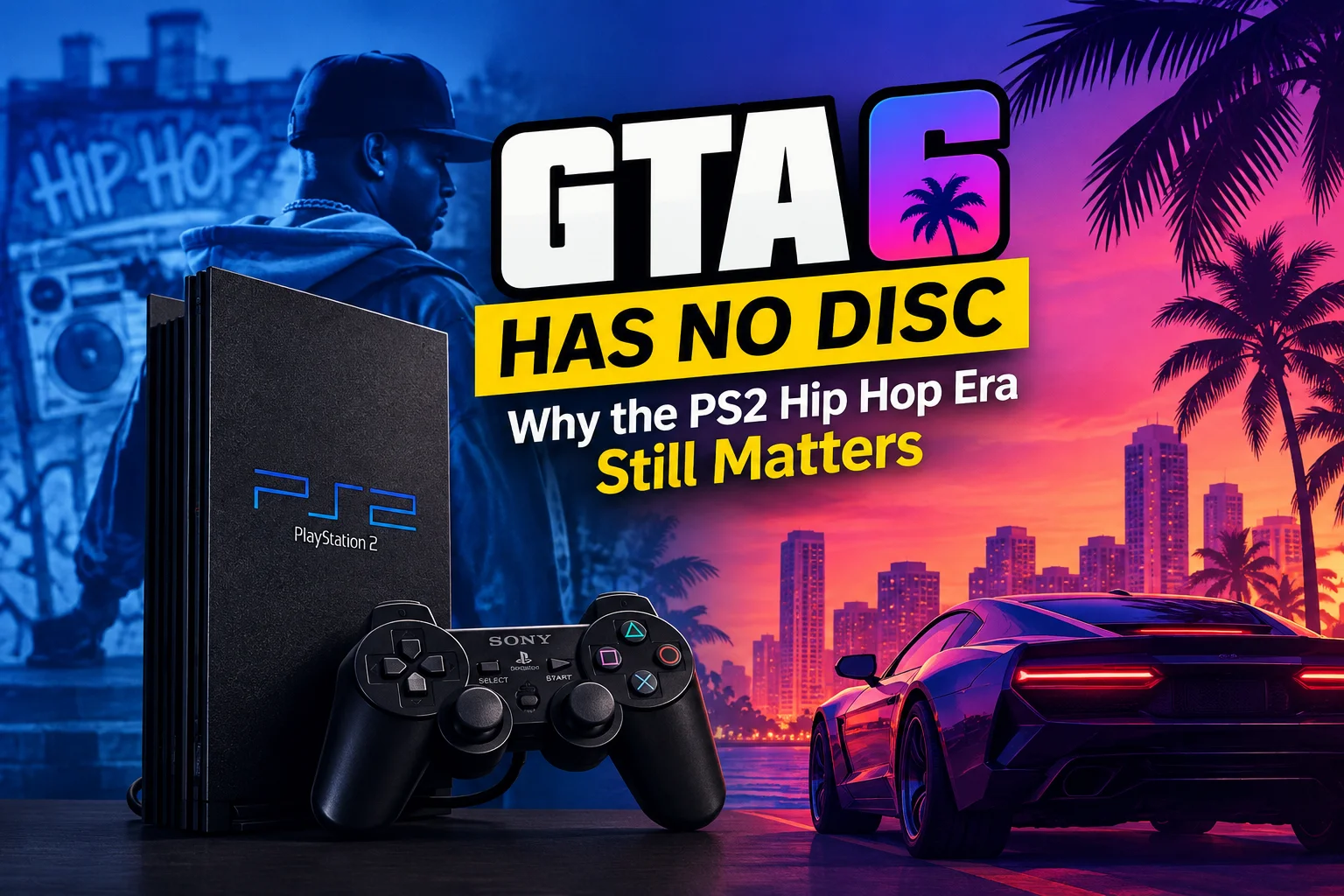

Over ninety percent of all modern video game sales are now completely digital downloads. Retail stores that once had aisles filled with shiny game cases now stock shelves with digital gift cards and plastic boxes containing download slips. When preorders opened for Grand Theft Auto VI, buyers discovered that the physical box edition contains no optical disc. This shift marks the end of an era and highlights why the physical PlayStation 2 era was so vital for gaming and music culture.
Physical game discs used to represent permanent ownership of art, music, and software. You bought a game once, placed it inside your console, and played it forever without worrying about internet connections or remote updates. The early two thousands created a golden moment where music artists and game developers joined forces on physical media. Looking back at the PS2 hip hop era shows us what we risk losing as gaming becomes entirely digital.
The Shock of a Disc Free Physical Release for GTA 6
Grand Theft Auto VI is tracking to become the biggest entertainment launch in modern history. The first preview videos generated hundreds of millions of views and pushed featured soundtrack songs to the top of music streaming charts. Fans rushed to preorder physical boxed editions to display on their shelves as collector items. Many were shocked to discover that the physical box contains only a printed voucher with a digital download code.
Buying a plastic box with no disc inside changes the fundamental relationship between players and game publishers. You are no longer purchasing a physical copy of software that you own forever. You are buying a revocable digital license that requires constant server verification to function. If servers go offline or licensing agreements change, your access to the game can change instantly.
This digital model gives publishers total control over the software after you pay for it. When a game exists purely as a cloud download, the creator can modify files, alter gameplay, and remove soundtrack songs through mandatory background updates. Players have no way to freeze their favorite version in time. The lack of a physical launch disc leaves the preservation of gaming history entirely in corporate hands.
When Hip Hop Ruled the PlayStation 2
Twenty years ago, video games treated urban music culture as the main event rather than background decoration. The PlayStation 2 era produced games built entirely around the personalities, style, and sound of rap music. Developers partnered directly with record labels to create interactive experiences that celebrated the golden era of the genre.
In 2004, gamers could pick up Def Jam Fight for NY and enter a brutal underground fighting tournament. You could put Ghostface Killah in a steel cage match against Busta Rhymes, or toss a rival fighter in front of a speeding subway train. Snoop Dogg played the villainous boss Crow, while Method Man, Redman, Ludacris, Scarface, Fat Joe, Lil Kim, and Flavor Flav stood ready as playable fighters. Electronic Arts handed the Def Jam artist roster to AKI Corporation, the legendary studio behind classic wrestling titles, creating one of the finest fighting games ever made.
Other major publishers followed this bold creative trend across diverse game genres. Activision hired Snoop Dogg as a fully playable unlockable character and soundtrack contributor in True Crime Streets of LA. Marc Ecko created Getting Up Contents Under Pressure, putting Talib Kweli and RZA inside a gritty story about graffiti writers fighting city corruption. Vivendi Universal produced 50 Cent Bulletproof, casting 50 Cent and the G Unit crew in an action packed crime shooter.
Rockstar Games took this cultural fusion to new heights with Grand Theft Auto San Andreas in 2004. The game featured radio stations like Radio Los Santos and Playback FM that defined the musical taste of an entire generation. Radio stations featured authentic disc jockeys, classic rap tracks, and hilarious commercials that felt like real street culture. Hip hop was not just a side feature; it was the beating heart of the virtual world.
The Licensing Trap That Buried Legendary Games
The early two thousands represented a rare window in entertainment contract law. Publishers could secure an artist music, physical likeness, voice acting performance, and branding in a single unified contract. Record labels and artists were eager to reach young gamers, leading to ambitious licensing agreements. However, these contracts were never designed to last forever.
Most soundtrack and celebrity likeness agreements in gaming were written with fixed ten year expiration dates. When those original licensing deals expired, publishers lost the legal right to sell the software. Bringing a game like Def Jam Fight for NY to modern digital storefronts is practically impossible today. A publisher would need to renegotiate separate agreements with more than forty artists, their record labels, music publishers, and estates under modern corporate terms.
The legal cost of relicensing dozens of legendary artists far outweighs the expected profit from a digital rerelease. Because no company is willing to fund that massive legal effort, classic hip hop games sit abandoned in corporate vaults. They cannot be remastered, ported to modern consoles, or sold on digital stores. The games remain trapped on their original physical discs, inaccessible to modern digital players.
Other classic games from that generation received digital remasters because their original assets were easy to clear. Fantasy adventure titles and racing games with generic soundtracks return to digital stores every year. Games built on licensed urban music and celebrity likenesses are left behind. The very cultural richness that made these titles special is what prevents them from returning to digital storefronts.
The GTA IV Soundtrack Update and the Danger of Digital Patches
The fragility of digital music licenses became painfully clear in April 2018 with Grand Theft Auto IV. Ten years after the game launched, the original music licensing contracts expired. Rockstar Games did not pull the game from sale; instead, they pushed a mandatory digital update to every connected console and computer.
The update quietly stripped dozens of beloved tracks from the radio dial across Liberty City. The hip hop station, The Beat 102.7, lost massive hits like Crackhouse by Fat Joe and Lil Wayne, along with Stylin by Papoose. The Classics station lost foundational golden era tracks, including All for One by Brand Nubian and Droppin Science by Marley Marl and Craig G. Droppin Science originally released in 1988, survived thirty years of music history, and was pulled from the game thirty years later over a software contract.
Players who bought the game on launch day in 2008 lost access to those songs the moment their consoles connected to the internet. The publisher reached directly into local hard drives and removed art that players had enjoyed for a decade. Even physical discs on modern connected consoles were forced to download the patch before starting. The original artistic vision of the game was permanently altered for digital owners.
text+-----------------------------------------------------------------------------------+
|                     THE EVOLUTION OF VIDEO GAME OWNERSHIP                        |
|                                                                                   |
| PS2 ERA (2000-2006)       ──> Complete software pressed onto optical disc         |
|                               (Cannot be altered, patched, or deleted remotely)   |
|                                                                                   |
| PS3 / PS4 ERA (2006-2020) ──> Digital patches remove expired music licenses      |
|                               (Console updates alter songs on your hard drive)    |
|                                                                                   |
| MODERN ERA (2020-Present) ──> Physical box contains download code with no disc    |
|                               (Zero local permanence, complete digital control)   |
+-----------------------------------------------------------------------------------+
Why PlayStation 2 Discs Are Unbreakable Time Capsules
The original PlayStation 2 release of Grand Theft Auto San Andreas represents an unalterable piece of history. The entire game, including every radio track, voice line, sound effect, and graphic texture, was pressed into the physical polycarbonate layer of the DVD disc. The PlayStation 2 console had no mandatory internet connection and no operating system capable of forcing background updates.
When you slide a San Andreas disc into a PS2 today, the game boots up exactly as it did in October 2004. You hear every original song on Radio Los Santos, unedited and complete. No corporate lawyer can reach into your living room and remove a track because a contract expired in 2014. The physical disc acts as an untouchable historical record.
Later releases of San Andreas on mobile phones, modern consoles, and digital storefronts suffered significant music cuts. Songs by artists like N.W.A., 2Pac, and Ice Cube vanished from digital editions over time. The only place where the complete, authentic artistic vision survives is on original physical media. Physical discs preserve culture exactly as it was experienced by the generation that lived it.
Comparing Physical Media with Digital Game Licenses
Understanding the practical differences between physical discs and digital download codes helps gamers protect their collections. The table below highlights how physical PS2 media compares directly with modern digital releases like GTA 6.
| Feature Comparison | Physical PS2 Optical Disc | Modern Digital Code Release |
|---|---|---|
| Ownership Type | Permanent personal property | Temporary revocable software license |
| Internet Requirement | Zero internet needed to play | Continuous internet required for setup |
| Soundtrack Security | Audio locked permanently on disc | Songs can be patched out when licenses end |
| Secondary Resale Value | High resale value on collector market | Zero resale value, locked to one user account |
| Long Term Preservation | Survives decades in proper storage | Depends entirely on publisher server uptime |
The Exploding Value of Retro Hip Hop Games
The failure of the digital market to preserve classic games has caused prices to skyrocket in the retro game market. When gamers realize that classic titles cannot be bought on digital stores, they search for original physical copies. Because the supply of undamaged discs shrinks every year, prices rise to match intense demand.
A loose PlayStation 2 disc of Def Jam Fight for NY with no case or instruction manual sells for around one hundred seventy dollars today. Complete copies with original artwork and manuals regularly fetch more than two hundred dollars. Factory sealed copies in pristine condition have sold for over one thousand dollars in public auctions. Def Jam Vendetta, the 2003 title that started the series, sells for thirty dollars loose and near two hundred dollars sealed.
These high prices are not driven by speculative bubbles; they are driven by genuine demand and zero legal digital supply. When millions of people want to experience a classic piece of entertainment and only physical discs remain, the secondhand market becomes the final archive. Ordinary games from that era still sell for ten or fifteen dollars, but licensed hip hop titles command luxury prices.
Retro game shops and mail trade services handle thousands of vintage games every month. The urban music titles are consistently the hardest games to keep in stock. Collectors, hip hop fans, and video game historians compete fiercely for the few surviving clean discs. The secondhand market has become an accidental library for twenty years of cultural history.
How the Broader Hip Hop Culture Preserved Its History
The hip hop community has done an extraordinary job preserving almost every other medium of its creative history. Classic rap albums from the nineteen eighties and nineties were successfully transitioned from vinyl records and cassette tapes to digital streaming platforms. Rare underground mixtapes recorded on magnetic tape in New York basements have been digitized and archived by dedicated fans.
Classic hip hop music videos that aired on late night cable shows are archived in high definition on video sharing websites. Vintage street magazines like The Source, XXL, and Vibe have been scanned page by page and preserved in digital public libraries. Documentary films, historic photography, concert flyers, and tour t shirts are collected and celebrated in major public museums worldwide.
Video games remain the single major area where the cultural record is slipping away. The problem is structural rather than a lack of interest from fans. A music album involves rights held by artists, producers, and record labels, but the music industry developed clear licensing formulas to keep tracks available for sale. Video games layer music rights on top of software engines, console manufacturer agreements, celebrity likeness contracts, and voice acting residuals.
When a classic game goes out of print, no single entity has the legal responsibility or financial incentive to untangle that web of rights. The original development studio is often shut down, the publisher may have merged, and the artists may be signed to different record labels. As a result, the entire work falls into a legal void where nobody can legally distribute it.
What Will Happen to GTA 6 in Ten Years?
Grand Theft Auto VI will launch with an incredible soundtrack featuring modern trap hits, classic funk, Latin beats, and Southern rap anthems. Players will spend hundreds of hours driving through virtual city streets with the radio playing their favorite songs. The music will become deeply connected to the memories players form in the game world.
Ten years after release, around the year 2035 or 2036, the soundtrack licenses for GTA 6 will expire. Because the physical release contains no disc, every player will be running a connected digital copy of the software. When the licensing contracts end, Rockstar Games will have to push a digital update that removes the expired tracks and replaces them with newer songs.
Players will turn on their consoles one morning and find that the iconic songs that defined their favorite missions are gone. Because there is no original physical disc pressed with launch day data, the original version of GTA 6 will disappear from legal circulation. Future players will only know the patched, altered version of the game. The launch day cultural artifact will exist only in internet video archives.
Practical Steps to Protect and Preserve Your Retro Game Discs
The games that survive for future generations will be the ones that players protect today. Thousands of classic PlayStation 2 discs are thrown into garbage bins every week during garage cleanouts and home moves. Discs are tossed into paper sleeves, shoved into hot attics, or left to scratch in dusty binders. Taking simple care steps ensures that your physical games survive for decades.
- Keep your game discs stored vertically inside their original hard plastic jewel cases away from direct sunlight.
- Avoid using cheap vinyl disc binders because plasticizer chemicals in the binder pages can degrade optical disc surfaces over time.
- Hold optical discs exclusively by the outer edge and center spindle hole to prevent skin oil and fingerprints from damaging data layers.
- Store your physical game collection in a climate controlled room with stable temperatures and low humidity to prevent disc rot.
- Clean dirty discs gently using a soft microfiber cloth wiped straight outward from the center hole to the outer edge, never in circular motions.
If you own a collection of PlayStation 2 games that you no longer play, do not throw them into household recycling bins. Check the value of your titles before clearing out your storage closets. Dedicated retro video game buying services help collectors trade, sell, or appraise rare titles safely. Keeping physical games in circulation helps preserve entertainment history for future generations.
The Cultural Significance of Preserving Interactive Art
Video games are not disposable consumer toys; they are sophisticated interactive art forms that capture the spirit of their time. A game like Def Jam Fight for NY captures the fashion, language, music, and energy of the early two thousands rap scene better than almost any documentary. It shows how the culture looked, sounded, and felt to the youth who lived through that era.
When we lose access to these games, we lose a piece of our shared cultural memory. Future historians and music fans will not be able to experience how urban music shaped digital entertainment at the turn of the century. Relying entirely on digital cloud servers means allowing corporate rights holders to decide which parts of our history are worth keeping.
Physical media provides an essential check against digital erasure. As long as physical discs exist in private collections and retro shops, the original art remains alive and accessible. The decision to release GTA 6 without a physical disc is a sobering reminder that digital convenience comes at the cost of permanent preservation.
Summary and Call to Action
The news that GTA 6 has no disc in its physical retail box marks a permanent turning point toward an all digital gaming landscape. While digital downloads provide instant access, they surrender long term ownership and leave cultural artifacts vulnerable to soundtrack removals and server shutdowns. The PlayStation 2 hip hop era proved that physical discs are durable time capsules that preserve music, art, and voice performances permanently against corporate licensing expirations.
Take action to protect physical gaming history today. Search your closets, basements, and attics for old PlayStation 2 games, and check what rare titles you own. Store your physical discs in their original cases, keep them clean, and never throw vintage gaming media in the trash. Cherish and preserve your physical game discs today so that the golden era of gaming and music lives on for generations to come.

Discussion
No comments yet. Be the first to share your thoughts!
Leave a Comment