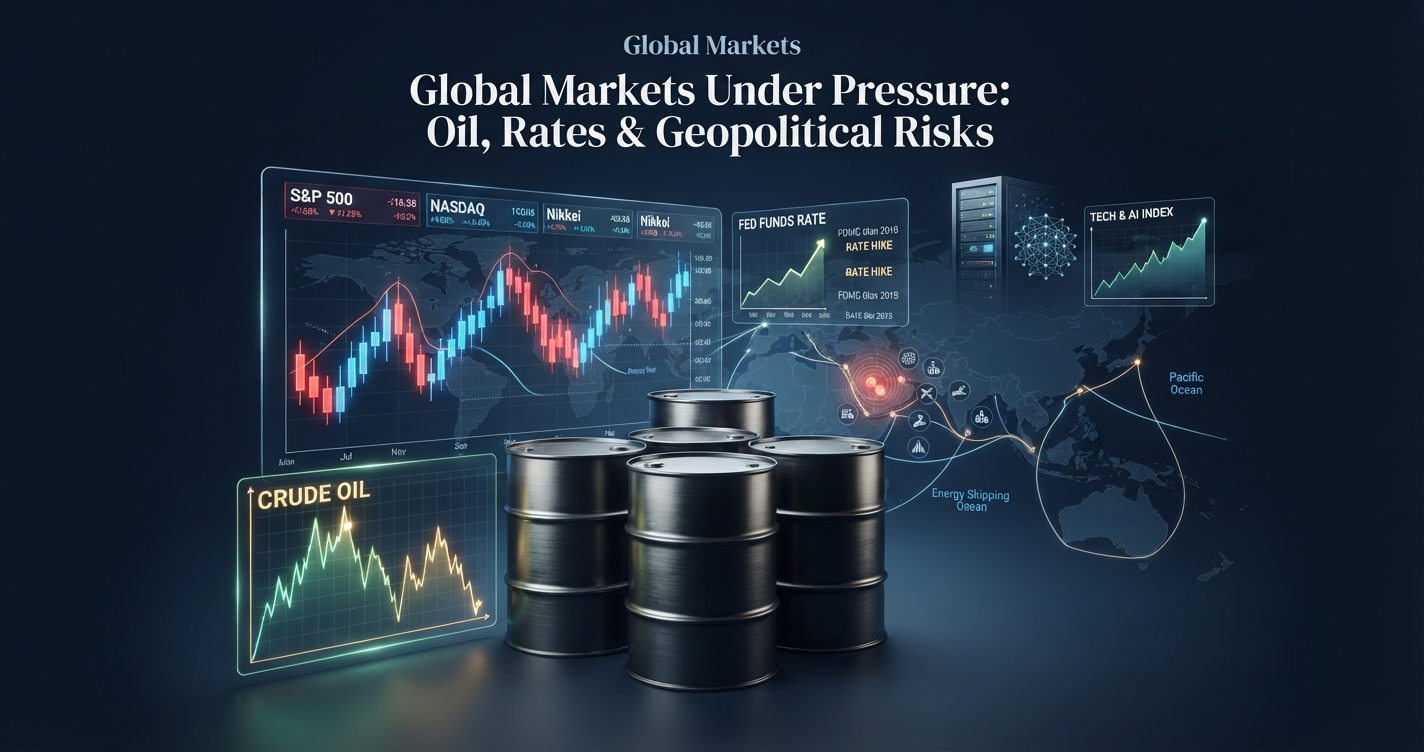
Global Markets Under Pressure: Oil, Rates & Geopolitical Risks
Global financial markets are entering September under pressure from several competing forces. Oil prices remain elevated as conflict in the Middle East threatens energy flows, expectations for U.S. interest-rate cuts are shifting following stronger employment data, and investors are closely watching major developments across the technology and financial sectors.
The combination of higher energy costs, changing monetary-policy expectations and geopolitical uncertainty is creating a complicated environment for businesses, investors and consumers around the world.
OPEC+ Keeps October Oil Policy Unchanged
One of the biggest developments in energy markets came from OPEC+.
At its September 6 meeting, OPEC+ decided to keep its existing oil output policy unchanged for October. The decision comes as the group continues to assess production levels, market conditions and the impact of disruptions affecting oil exports. Reuters reported that the group is also turning its attention toward negotiations over production quotas for 2027.
The decision is particularly important because global oil markets are already dealing with uncertainty caused by geopolitical tensions and disruptions around major supply routes.
For businesses, sustained oil prices can increase transportation, manufacturing and operating costs. Consumers can also feel the impact through higher gasoline, diesel, airline and delivery costs.
Middle East Conflict Keeps Energy Markets on Edge
Geopolitical tensions have become a major factor influencing oil prices.
Renewed military exchanges involving the United States and Iran have increased concerns about potential disruptions to Middle Eastern energy supplies. Reuters reported that Brent crude ended the week at $96.28 per barrel, while U.S. West Texas Intermediate reached $91.48 after significant weekly gains.
The Strait of Hormuz remains especially important because it is a major route for global energy shipments. Any prolonged disruption in the area could create additional pressure on crude oil and refined fuel markets.
This means that oil prices may continue responding not only to traditional supply-and-demand factors but also to developments in geopolitics and shipping security.
Gasoline Prices Reach Record Labor Day Levels
Higher crude prices are also reaching consumers.
According to Reuters, the U.S. national average gasoline price was expected to reach approximately $4.03 per gallon over the 2026 Labor Day weekend, exceeding the previous Labor Day record of $3.83 set in 2012.
The increase has been linked to higher crude prices, Middle East tensions and concerns about fuel supplies. U.S. refinery utilization has also been running at very high levels, limiting how much additional refining capacity can immediately offset the pressure.
Higher fuel prices can have effects far beyond the gas station. Transportation companies, airlines, delivery services and manufacturers can all face higher operating expenses when energy costs rise.
Strong U.S. Jobs Data Changes Interest-Rate Expectations
Energy markets are not the only source of uncertainty.
U.S. employment data has also influenced expectations about the Federal Reserve's future monetary policy.
Citigroup recently pushed back its forecast for the Federal Reserve's next interest-rate cut to June 2027, following stronger-than-expected U.S. employment data.
Interest-rate expectations matter because borrowing costs influence businesses, consumers and financial markets.
If interest rates remain higher for longer, companies may face increased financing costs, while consumers could continue paying more for loans and other forms of credit. Higher rates can also influence stock valuations and investment decisions.
At the same time, policymakers must balance employment conditions against inflationary pressures, particularly when energy prices are rising.
Oil Prices Could Add to Inflation Concerns
The combination of higher energy prices and interest-rate uncertainty creates a difficult situation for central banks.
Energy is an important component of the broader economy. When oil and fuel prices rise significantly, businesses may pass some of those additional costs to customers.
That can make the inflation outlook more complicated.
Reuters has reported that rising oil prices and higher bond yields have already contributed to pressure across financial markets in September.
If energy prices remain elevated for an extended period, investors may begin reassessing expectations for monetary-policy easing in several major economies.
Anthropic IPO Becomes a Major AI Market Test
The technology sector is also contributing to the changing business landscape.
Anthropic, the artificial intelligence company behind Claude, has confidentially submitted a draft registration statement to the U.S. Securities and Exchange Commission for a proposed initial public offering. The company has said that the offering remains dependent on market conditions and other factors.
More recently, Reuters reported that Anthropic's IPO marketing could begin in mid-October at the earliest, with the public prospectus now expected later in September. The timing remains subject to change.
The potential IPO is attracting significant attention because it could become an important test of investor appetite for major artificial-intelligence companies.
A successful public offering could strengthen confidence in the commercial value of AI businesses. However, market volatility, high expectations and questions about AI spending could also make the offering closely watched by investors.
Citigroup Expands Its International Strategy
Financial institutions are also continuing to expand internationally despite uncertainty in global markets.
Citigroup is reportedly seeking regulatory approval for a wholly owned brokerage business in China as soon as September. Reuters reported that the bank expects to add several employees once the business receives approval.
The move highlights how major financial institutions continue to pursue international opportunities even as geopolitical tensions reshape global trade and investment relationships.
International expansion can provide access to new clients and markets, but it also exposes companies to regulatory, political and economic risks.
What These Developments Mean for Global Businesses
Several major trends are now interacting with each other:
Oil markets: OPEC+ is maintaining its October output policy while geopolitical tensions continue affecting supply expectations.
Fuel prices: Higher crude prices are contributing to expensive gasoline and diesel.
Interest rates: Strong U.S. employment data has changed expectations for future Federal Reserve cuts.
Inflation: Higher energy costs could complicate efforts to reduce inflation.
Technology: Anthropic's potential IPO is becoming an important event for the AI investment market.
Financial services: Citigroup and other global institutions continue pursuing international expansion.
Geopolitics: Conflicts and trade relationships are increasingly influencing financial markets.
These developments demonstrate how closely connected the global economy has become. A disruption in an energy-producing region can affect fuel prices, transportation costs, inflation and central-bank policy far beyond that region.
What Investors and Businesses Should Watch Next
The coming weeks could provide more clues about the direction of global markets.
Investors will be watching oil prices, developments around the Middle East, upcoming U.S. inflation and employment data, and signals from the Federal Reserve.
Businesses will also need to monitor energy expenses, borrowing costs and changes in consumer demand.
Meanwhile, major corporate events such as Anthropic's potential IPO could provide a broader indication of whether investors remain willing to assign high valuations to fast-growing technology and AI companies.
The Bigger Picture
Global markets are currently being shaped by several forces at the same time.
OPEC+'s decision to maintain its October oil policy provides some continuity, but geopolitical risks continue to create uncertainty around energy supplies. At the same time, stronger U.S. employment data has changed expectations for interest-rate cuts, while higher oil prices could create additional inflation pressure.
The potential Anthropic IPO and Citigroup's international expansion show that companies are still pursuing growth despite these challenges.
For businesses and investors, the key issue is no longer just one market or one economic indicator. Energy, monetary policy, technology, geopolitics and international trade are increasingly interconnected.
As September progresses, developments in these areas could play an important role in determining the direction of global markets for the remainder of 2026.
Sources
Reuters — OPEC+ keeps October oil output policy unchanged
Reuters — Record-high Labor Day gasoline prices
Reuters — Citigroup delays Fed rate-cut forecast



Discussion
No comments yet. Be the first to share your thoughts!
Leave a Comment