
- Download massive software files, games, and ultra high definition videos in less than one second.
- Experience crystal clear three dimensional video calls with friends, teachers, and family members.
- Enjoy reliable high speed internet coverage while flying on airplanes or traveling through remote regions.
- Benefit from safer roads as self driving vehicles share position data instantly with nearby cars.
- Reduce household energy waste through smart appliances that adjust power use to match daily habits.
- Invest in extensive fiber optic backhaul lines to connect upcoming cell sites to central data hubs.
- Establish clear international spectrum allocations to avoid signal conflicts between satellite and terrestrial towers.
- Upgrade municipal zoning rules to allow installation of compact micro towers and smart reflective panels on public streetlights.
- Strengthen digital cybersecurity defenses to protect dense Internet of Things networks from unauthorized access.
- Train engineers, software developers, and technicians in high frequency radio design and smart networking.
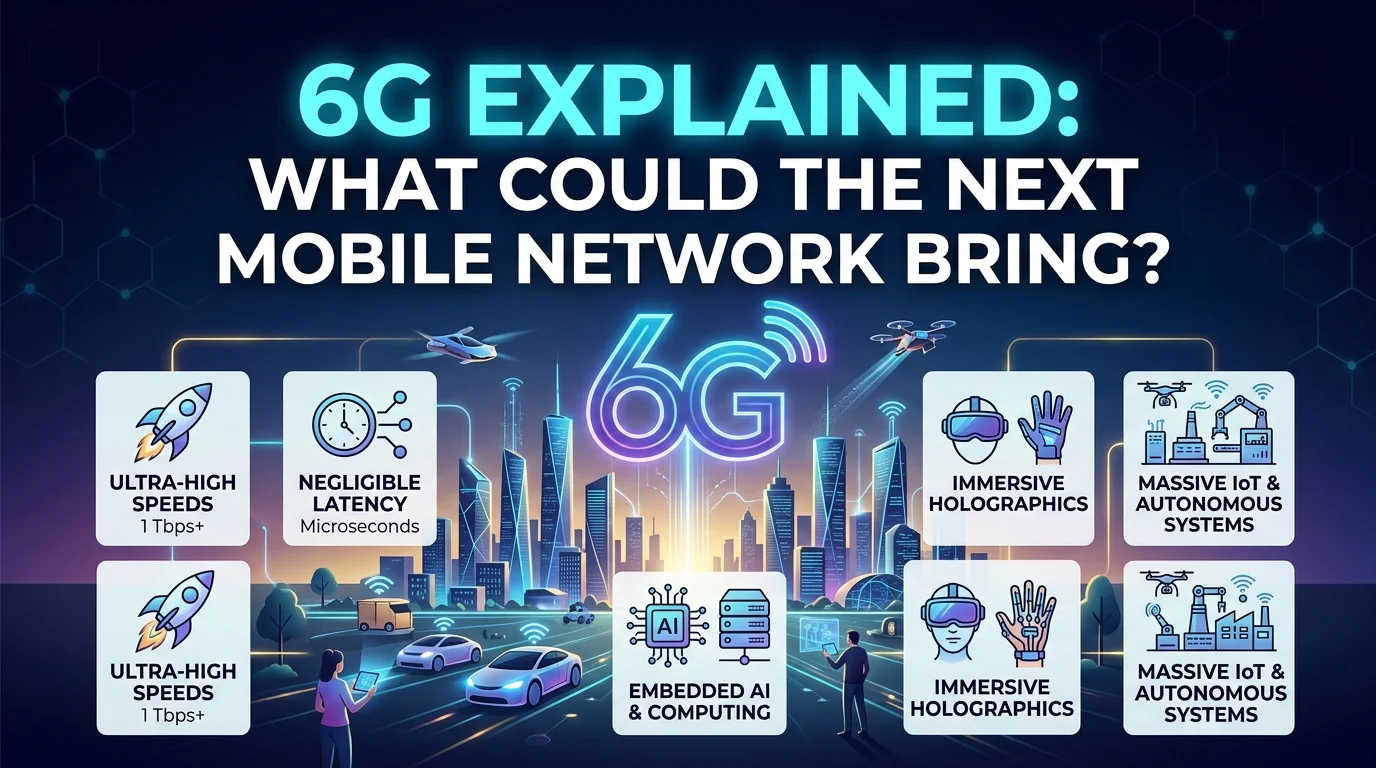
Global mobile data traffic will pass five thousand exabytes per month by the year twenty thirty. That staggering amount of information is more than twenty times the data generated across the entire planet a decade ago. While fifth generation wireless networks continue to expand across cities, telecommunications engineers are already creating the next standard. 6G Explained reveals how upcoming wireless advancements will reshape personal communication, transportation, and home automation.
Every previous generation of mobile technology delivered a distinct breakthrough for consumers. Second generation networks brought text messaging, third generation brought basic web browsing, and fourth generation made video streaming common everywhere. Fifth generation networks improved reliability and added support for industrial sensors. The Next Mobile Network promises to combine high speed radio waves, satellite coverage, and artificial intelligence into a single seamless system.
What Is 6G Technology in Simple Terms?
Mobile networks use invisible radio waves to transmit audio, video, and text messages between devices and cell towers. Each new generation expands the radio frequencies that towers can use to move information back and forth. 6G technology will use much higher radio bands known as sub terahertz and terahertz frequencies. These higher frequencies carry massive amounts of information through the air in fractions of a second.
A standard 6G connection will feel instantaneous to anyone using a connected screen or headset. Instead of waiting for files to download or video streams to buffer, content will open immediately. The network will also sense physical environments using radio signals, acting like a giant radar system for smart cities. This combination of sensing and data transmission sets the upcoming standard apart from previous wireless iterations.
Researchers around the world are currently writing the technical rules that will govern how equipment talks to towers. International standards groups want to make sure devices work smoothly in every country across the globe. Major tech firms and universities are building experimental microchips that can transmit data at these extreme radio frequencies. The groundwork happening right now will shape our daily communications for decades to come.
How 6G Compares to 5G Networks
Comparing these two network standards highlights how quickly telecommunications technology is moving forward. Fifth generation networks offer theoretical peak download speeds of twenty gigabits per second in ideal laboratory conditions. In contrast, 6G Network Speed targets one terabit per second, which is fifty to one hundred times faster. A full length high definition movie could download to your storage drive in a fraction of a single second.
Network responsiveness is another area where the new standard creates a dramatic improvement. Latency is the short delay between sending a digital request and receiving a response from a server. Current networks produce latency between ten and thirty milliseconds during everyday operations. Upcoming sixth generation infrastructure aims to lower that delay to less than one tenth of a millisecond.
Capacity limits will also expand significantly to handle billions of newly connected smart devices. Fifth generation towers can support about one million connected devices within a single square kilometer. Sixth generation towers will be able to handle ten million devices in that same geographic space without dropping signals. This massive capacity ensures that crowded stadiums and busy downtown street corners never suffer from slow data speeds.
The Power of Terahertz Frequencies and Radio Spectrum
Radio spectrum is the invisible highway that wireless signals travel on to reach your handheld screen. Lower frequencies can travel long distances and pass easily through concrete walls, but they carry less data. Higher frequencies carry enormous amounts of data, though they cover shorter physical distances. Sixth generation equipment will tap into the terahertz range between one hundred gigahertz and three terahertz.
Operating at these extreme frequencies requires specialized microchips made from advanced semiconductor materials. Engineers are developing tiny antenna arrays that can steer radio beams directly at moving devices. This beam steering technique prevents signal loss and concentrates energy exactly where users need it. By focusing signals into narrow beams, towers can deliver maximum speed with minimal power waste.
Terahertz waves also interact with physical matter in ways that create exciting new possibilities for wireless sensing. Radio waves bouncing off objects can detect moisture in the air, track movement, and recognize materials. A cell tower could monitor weather patterns, detect air pollution levels, and track traffic congestion simultaneously. The network becomes a giant environmental sensor while continuing to carry voice and video traffic.
Near Zero Latency: Ending Lag for Good
Gamers and video callers are familiar with the annoyance of screen lag and frozen audio streams. Lag happens when data packets take too long to travel between personal devices and distant cloud servers. Achieving near zero latency means delays become so tiny that the human brain cannot perceive them at all. Every tap, click, and voice prompt produces an immediate physical or visual reaction on screen.
Industrial operations depend heavily on instant communication to control heavy machinery and robotic arms safely. If an automated crane on a construction site detects a person nearby, it must stop within a millisecond. Near zero latency allows cloud computers to make safety calculations and stop heavy equipment without dangerous delays. This extreme precision makes automated workplaces safer and more reliable for human workers.
Remote music performances and theater collaborations will also become possible without timing errors. Musicians located in different cities will be able to play instruments together in real time without audio delay. Medical professionals will control robotic tools during emergency surgeries from thousands of miles away with complete tactile feedback. Eliminating network delay transforms how people work and create together across vast distances.
Holographic Communication: Talking to Life Size Projections
Video calls have become an everyday tool for school classes, business meetings, and family checkups. The Future of 6G will push visual communication far beyond flat two dimensional glass screens. High capacity networks will carry full three dimensional holographic data directly into living rooms and meeting spaces. You will be able to sit across a table from a realistic projection of a friend or coworker who lives on another continent.
Building a true holographic projection requires sending hundreds of gigabits of spatial data every single second. Multiple specialized cameras must capture depth, lighting, and minute facial movements simultaneously. The network must process and deliver those visual points in real time to prevent glitching or distorted movements. Sixth generation bandwidth provides the massive data pipes necessary to make volumetric video calls smooth and believable.
Immersive educational experiences will change how students learn about science, history, and engineering. A biology classroom can examine a floating three dimensional model of a beating heart from every possible angle. History students can walk through accurate historical recreations and interact with digital museum artifacts. These visual experiences make complex subjects easy to grasp for learners of all ages.
Global Satellite Integration: Internet in the Sky and Seas
Current cellular networks rely heavily on ground towers connected by buried fiber optic cables. This setup leaves vast deserts, open oceans, and remote mountain ranges without reliable internet reception. Sixth generation planning includes non terrestrial networks that link ground towers directly with low Earth orbit satellites. Airplanes, cargo ships, and remote villages will enjoy the exact same high speed data access as major cities.
Satellite integration means you will never lose cell phone reception while hiking in deep wilderness areas or sailing offshore. Devices will switch smoothly between local ground antennas and overhead satellites without dropping active calls. This continuous coverage will improve safety for outdoor adventurers, transport workers, and rural emergency response teams. Help can be dispatched immediately to any coordinate on the planet without communication blackouts.
Global connectivity will also help international logistics companies track freight shipments across oceans in real time. Cargo containers equipped with low power sensors will report temperature, humidity, and exact location throughout transit. If refrigerated food shipments warm up during a voyage, managers can take corrective action before food spoils. Total visibility across global trade routes reduces waste and lowers shipping expenses.
Smart Cities and Autonomous Transportation
Self driving cars require continuous access to high speed data to navigate crowded city streets safely. Vehicles must communicate with traffic lights, roadside cameras, and neighboring cars to avoid sudden collisions. 6G connectivity enables instant vehicle to everything communication, sharing speed and braking data across entire intersections. Traffic flows smoothly because traffic lights adjust green light cycles based on real vehicle movements.
Municipal utility systems will use connected sensors to manage water distribution, electrical power, and trash collection. Water pipes equipped with acoustic sensors can detect tiny leaks beneath roads before streets suffer sinkhole damage. Electrical grids can balance renewable energy from rooftop solar panels across neighborhoods during peak heat hours. These automated adjustments lower city operating expenses and reduce carbon footprints for urban populations.
Emergency services will reach accident scenes faster by coordinating with automated city traffic systems. Traffic lights can clear paths for approaching ambulances and fire trucks blocks before they arrive at intersections. Drones flying ahead of emergency crews can broadcast high resolution video of accident scenes to hospital doctors. This advanced preparation gives medical teams vital minutes to prepare lifesaving treatments.
Major Everyday Benefits You Can Expect from 6G
The transition to sixth generation mobile connectivity will introduce practical improvements for everyday life:
Transforming Healthcare and Remote Medical Care
Medical technology will experience substantial upgrades once sixth generation wireless infrastructure goes live. Wearable health monitors will track vital signs continuously and alert medical teams to early warning signs of illness. Microscopic biosensors swallowed in pills could monitor internal gut health and stream data directly to physician dashboards. Early detection helps doctors treat health conditions before they become serious emergencies.
Paramedics inside connected ambulances will perform advanced scans and share three dimensional imagery with trauma surgeons. Specialists at central hospitals can guide emergency treatments step by step while the ambulance speeds toward the emergency room. This rapid collaboration saves critical brain and heart tissue during strokes and sudden cardiac events. Instant data access turns standard emergency vehicles into mobile treatment clinics.
Robotic physical therapy will allow recovering patients to perform guided exercises safely at home. Smart robotic suits can provide physical support while measuring muscle strength and joint movement during recovery sessions. Physical therapists can monitor patient progress remotely and adjust resistance levels in real time through the network. Patients recover faster without the stress and expense of frequent hospital visits.
Built In Artificial Intelligence in Cellular Towers
Previous network generations used artificial intelligence as an add on tool to analyze network performance reports. Sixth generation infrastructure will feature smart computing models built directly into base stations and cell towers. These smart antennas will monitor radio interference, predict user demand, and reconfigure signal paths on their own. The network heals itself during equipment failures by routing data around damaged components instantly.
Smart bandwidth allocation will ensure that critical data streams always receive top priority over casual web browsing. If an autonomous ambulance approaches a busy street, the nearby cell tower shifts bandwidth away from streaming apps to the vehicle. Once the emergency passes, normal bandwidth allocations return to surrounding smartphones automatically. This intelligent prioritization keeps public safety systems running without interruption.
Cellular towers will also use predictive computing to power down transmitter components when foot traffic drops at night. Antennas will wake up instantly as pedestrians or vehicles approach the coverage zone. This dynamic power management reduces electricity consumption across telecommunications networks, lowering operating costs and emissions. Smart software turns energy hungry cell towers into environmentally responsible infrastructure.
Environmental Sustainability and Energy Efficiency
Energy consumption is a major concern as billions of new connected devices join wireless networks worldwide. Telecommunications engineers are prioritizing power efficiency in every aspect of sixth generation hardware design. New microchips are engineered to transmit more bits of data while drawing significantly less electrical power from batteries. This efficiency allows small sensors to operate for ten years on a single button cell battery.
Ambient energy harvesting is an exciting development in next generation sensor research. Many tiny 6G sensors will operate without any traditional batteries by capturing power from surrounding light, vibrations, and radio waves. These zero power devices can be placed inside building walls, bridges, and roads to monitor structural integrity for decades. Eliminating battery replacements lowers maintenance costs and prevents electronic waste in landfills.
Greener telecommunications networks support broader global efforts to combat climate change. Smart water meters, crop soil sensors, and forest fire monitors will run continuously without human maintenance. Farmers can apply exact amounts of water and fertilizer only where soil sensors indicate dry conditions. Precise resource management conserves fresh water supplies and prevents excess fertilizer runoff into rivers.
Technical Obstacles Engineers Must Solve
Building hardware that operates reliably at terahertz frequencies presents formidable physical hurdles. Terahertz radio waves have very short wavelengths that struggle to travel through rainfall, fog, foliage, and brick walls. Even the moisture present in normal humid air absorbs these high frequency signals rapidly. Engineers must design dense networks of small repeaters and smart reflective surfaces to bounce signals around buildings.
Manufacturing costs for advanced sub terahertz chips remain very high compared to standard silicon chips. Foundries must invent new fabrication methods using materials like gallium nitride and indium phosphide to produce affordable chips. Without low cost manufacturing, consumer smartphones with 6G capabilities would be too expensive for average buyers. Semiconductor makers are investing billions into new fabrication lines to solve these cost bottlenecks.
Heat generation is another significant engineering problem inside small handheld devices. Processing terahertz data streams produces substantial warmth that can quickly drain smartphone batteries and degrade internal components. Hardware designers must invent novel cooling systems and low power processing architectures to keep devices cool. Solving the heat problem is essential before commercial devices can hit retail shelves.
Expected Timeline: When Will 6G Be Available?
Developing a global wireless standard takes roughly ten years of steady research, testing, and international coordination. We are currently in the foundational research phase where scientists test radio frequencies and build experimental components. Telecommunications standards bodies will begin defining formal technical specifications between twenty twenty six and twenty twenty eight. These formal rules establish universal guidelines that all hardware makers must follow.
Commercial trials and prototype network testing are expected to begin in major cities around twenty twenty eight. Early deployments will likely focus on industrial manufacturing plants, ports, and smart city infrastructure projects. Consumer rollout will follow as smartphone manufacturers release compatible handsets. Most industry roadmaps project that widespread consumer access to 6G networks will begin around the year twenty thirty.
Fifth generation networks will continue to expand and improve throughout the remainder of this decade. Upgrades known as 5G Advanced will introduce intermediate speed boosts and efficiency gains to bridge the gap until the next standard arrives. Consumers do not need to worry about their current phones becoming obsolete anytime soon. Fifth generation infrastructure will serve as the primary wireless backbone for years to come.
Steps Communities and Industry Leaders Must Take
Preparing for the next era of high speed wireless connectivity requires proactive planning today:
Security, Data Privacy, and User Protection
Connecting billions of physical sensors and everyday items to a single wireless network creates new digital safety challenges. If every appliance, camera, and vehicle communicates online, securing those data pathways is vital. Sixth generation standards are being designed with builtin zero trust security protocols from the very beginning. Every device, data packet, and network node must prove its identity before sharing information.
Quantum resistant encryption algorithms are being integrated into future communication standards to protect sensitive records. Traditional encryption codes could become vulnerable to future quantum processors in the coming decades. Using post quantum cryptographic keys ensures that personal medical data, bank transfers, and city traffic controls remain safe from interception. Proactive digital security prevents data theft before new threats emerge.
Privacy regulations must also evolve alongside spatial sensing capabilities. Because 6G towers can detect physical shapes and movements in their vicinity, strict rules are required to prevent unauthorized surveillance. Consumers must retain total control over how their personal location and movement records are collected and stored. Transparent privacy policies build user trust and ensure safe everyday technology adoption.
A Connected Future on the Horizon
6G Explained shows that the upcoming generation of wireless connectivity is much more than a modest speed upgrade. By blending terahertz radio spectrum, satellite networks, instant responsiveness, and spatial sensing, it transforms how we live and work. From holographic family chats to safer self driving commutes, the benefits will touch every part of modern life.
While broad commercial rollout remains several years away, the basic building blocks are taking shape in laboratories right now. Engineers, researchers, and cities are working together to solve the physical and economic challenges of high frequency communication. The Next Mobile Network will bridge digital divides, connect remote corners of our planet, and power useful technologies. Stay curious about these developing wireless trends as the world prepares for the arrival of 6G connectivity.

Discussion
No comments yet. Be the first to share your thoughts!
Leave a Comment