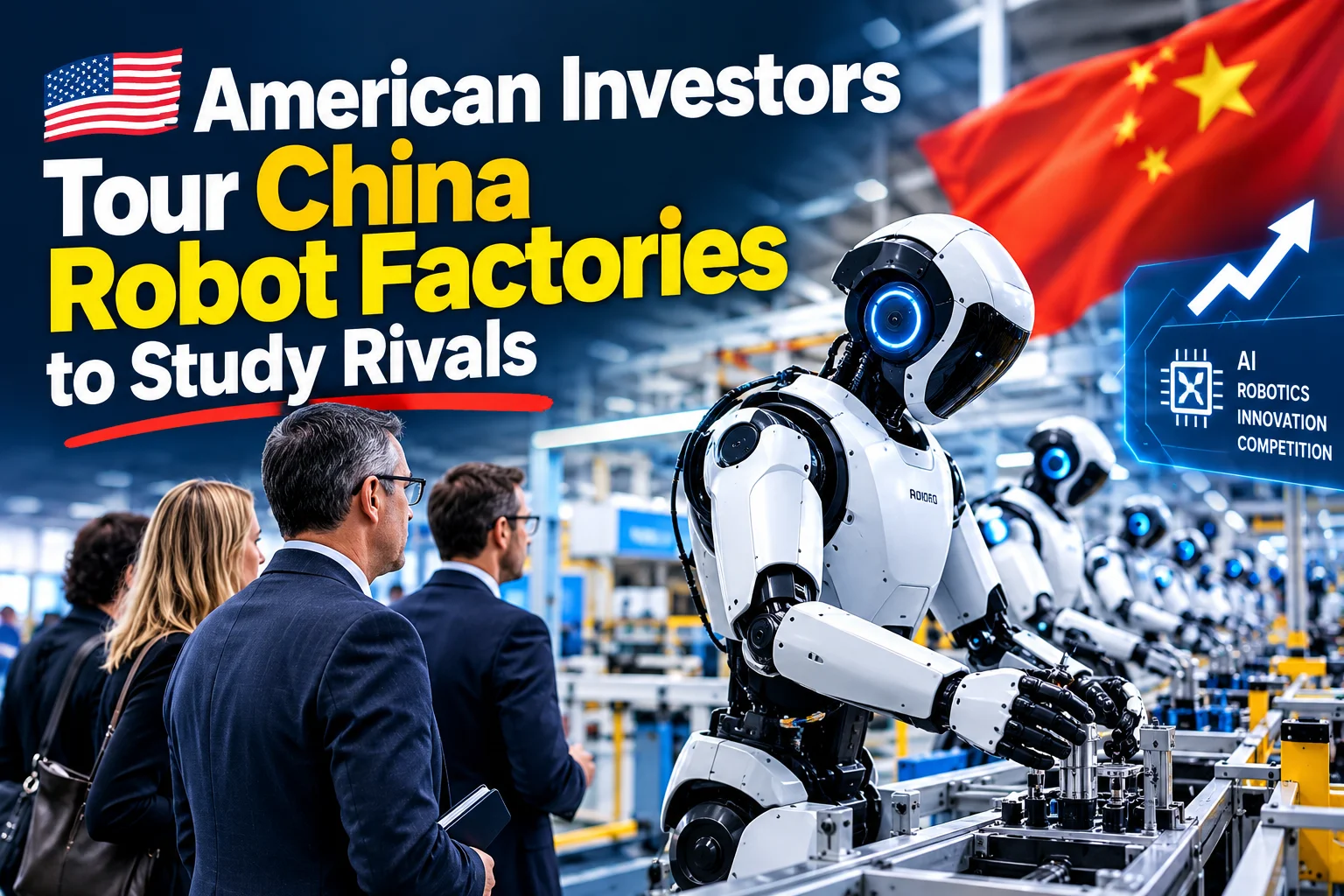

China installed more than two hundred and ninety thousand industrial robots in a single year, representing more than half of all robot installations across the entire planet. That staggering number is more than double the combined total of the United States and Europe. American venture capitalists, hedge fund managers, and technology executives are now booking flights to manufacturing centers like Shenzhen, Shanghai, and Dongguan. They want to walk the factory floors and see firsthand how fast Chinese competitors are building mechanical hardware.
Silicon Valley has long dominated artificial intelligence software, but physical machines require physical factories. Investors who previously focused purely on software algorithms now recognize that hardware execution determines who wins the automation race. Walking through automated assembly lines gives financial backers a clear look at component costs, production speed, and engineering talent. This in person inspection helps Western investors evaluate their own portfolio companies against fierce global rivals.
Why American Investors Are Flying to Asian Factory Floors
Reading quarterly research reports from thousands of miles away cannot replace seeing active assembly lines with your own eyes. American investors want to verify whether foreign claims about robot production rates and performance are real. Visiting plants allows analysts to inspect the precision of robotic arms, examine the quality of electric motors, and watch humanoid machines walk across factory floors.
Direct site visits also reveal how quickly foreign engineering teams turn digital blueprints into working metal prototypes. In Silicon Valley, ordering custom metal gears or specialized silicon boards often takes weeks of waiting for overseas shipments. In cities like Shenzhen, engineers can design a part in the morning and have a physical prototype delivered to their workbench by dinner. Experiencing that rapid turnaround time changes how investors calculate development cycles.
Understanding production costs is another major driver behind these factory tours. Investors need to know the exact bill of materials for building a bipedal robot or an automated warehouse cart. Knowing whether a foreign competitor can manufacture a robotic joint for fifty dollars while an American startup spends five hundred dollars determines where capital should flow. These financial details shape multi million dollar investment decisions.
Inside Modern Chinese Robotics Plants
Stepping inside a modern robotics plant in southern China feels like walking into the future of manufacturing. Rows of autonomous mobile carts glide across polished concrete floors, carrying metal casings and wiring harnesses to automated workstations. High precision robotic arms weld, screw, and polish parts without human hands touching the metal. Human technicians sit in control rooms monitoring digital dashboards that track component assembly in real time.
Many facilities dedicate large sections of their floor space to stress testing brand new humanoid machines. You can see dozens of two legged robots walking on treadmills, climbing obstacle stairs, and carrying heavy storage boxes. High speed cameras and floor sensors record every footstep to measure joint balance and motor heat. The testing runs twenty four hours a day to identify mechanical failures quickly.
Cleanliness and organization inside these plants rival the finest semiconductor cleanrooms in the world. Engineers wear anti static suits while assembling sensitive optical sensors, lidar scanners, and circuit boards. Automated quality control stations use artificial vision cameras to inspect every screw thread and solder joint for microscopic defects. The scale and discipline of these operations dispel outdated myths about low quality manufacturing.
The Extreme Speed and Cost Advantages of Local Supply Chains
The greatest strength of China robotics ecosystem is the dense cluster of specialized component suppliers located within a single geographic region. A robot manufacturer in the Pearl River Delta can source electric motors, lithium battery packs, harmonic speed reducers, and aluminum frames from suppliers located less than an hour away. This close physical proximity eliminates shipping delays and reduces shipping costs to almost zero.
When an engineering team needs to modify a metal bracket or test a different gear ratio, they call a local machine shop down the street. The supplier adjusts the tooling and delivers fresh parts the very next day. This constant iteration allows development teams to test ten design revisions in the time it takes a Western team to test two. Speed of iteration is the ultimate competitive advantage in physical hardware engineering.
Component pricing drops dramatically when suppliers operate at massive domestic scale. Chinese suppliers produce millions of electric motors and battery cells for electric vehicles, smartphones, and household appliances. Robotics companies tap into these existing high volume supply lines to buy precision parts at rock bottom prices. Western startups building low volume prototypes simply cannot match these component discounts.
Humanoid Robots: The New Frontier of Automation
Humanoid robots designed with two arms, two legs, and a torso represent the most hotly contested area of modern robotics. Tech giants like Tesla, Figure AI, and Boston Dynamics have captured global attention with their walking prototypes. However, dozens of Chinese robotics firms have quickly introduced their own functional humanoid models at remarkably low prices. Several companies already market full size bipedal robots for less than thirty thousand dollars.
These machines are built to operate in human environments like warehouses, car factories, and commercial kitchens without changing the building layout. They can climb standard stairs, open regular door handles, and pick up packages designed for human hands. Chinese manufacturers are already testing these robots on actual automotive assembly lines to install interior car trim and move heavy parts.
American investors are watching this space closely because mass production will drive prices down even further. If a humanoid robot costs twenty thousand dollars and works reliably for three years, it changes the economics of factory labor worldwide. Investors want to see which companies possess the supply chain power to build tens of thousands of reliable units each year. The race is no longer about making a robot walk in a video, but about building them by the thousands.
Hardware Muscle Meets Software Brains
The global robotics competition highlights a fascinating contrast between American and Chinese technological strengths. American firms currently lead the world in advanced artificial intelligence models, visual perception algorithms, and simulation software. Leading laboratories in California build software brains that allow robots to reason, learn from mistakes, and understand spoken natural language commands.
Chinese companies excel at mechanical hardware engineering, precision machining, and rapid manufacturing scale. They build strong robot bodies, durable joint actuators, efficient cooling systems, and lightweight metal frames. When you pair American software with Chinese hardware efficiency, machines become extraordinarily capable and affordable. Investors are studying how these two distinct strengths will interact in the global marketplace.
Some investors believe that hardware will become a cheap commodity while software retains all the profit value. Others argue that precision mechanical engineering is extremely hard to copy and provides a strong moat against competitors. Walking through robot plants helps investors decide whether they should back pure software platforms or integrated hardware makers. The debate over software versus hardware value is central to modern venture capital strategy.
Key Findings from Investor Factory Inspections
Investors who tour manufacturing hubs observe clear patterns that define the current state of global robotics manufacturing:
- Prototype development cycles in specialized industrial clusters move three to four times faster than standard Western development timelines.
- Humanoid robot bill of materials costs are falling rapidly due to shared components from the massive electric vehicle supply chain.
- Factory automation in foreign plants is being driven by domestic manufacturing needs and rising local labor costs.
- Artificial intelligence software integration remains the primary bottleneck for foreign robot makers seeking full autonomy.
- Proximity between mechanical design engineers and factory assembly workers prevents costly manufacturing mistakes early in the design phase.
The Geographic Power of Supply Chain Clusters
The concept of industrial clustering explains why certain cities become dominant manufacturing powerhouses. In Dongguan and Shenzhen, thousands of specialized businesses operate in close harmony within a small physical area. One city block might contain precision metal casting, plastic injection molding, wire harness manufacturing, and custom circuit board printing.
This dense network creates an economic ecosystem where specialized knowledge spreads quickly from shop to shop. Technicians move between companies, taking valuable operational knowledge and engineering tricks with them. Suppliers compete fiercely on price and turnaround speed, driving continuous efficiency gains across the entire city. It is nearly impossible for an isolated factory in North America or Europe to match the speed of an entire integrated industrial city.
American investors visiting these regions realize that rebuilding such supply ecosystems at home will take decades of focused investment. Even with massive government subsidies, building factories without local part suppliers creates logistical friction. Investors must consider these geographical realities when funding Western hardware startups that rely on overseas parts.
Strong Policy Support and Real World Test Environments
Government initiatives provide massive financial support and regulatory backing to the domestic robotics industry. Cities create dedicated robotics industrial parks that offer free rent, subsidized electricity, and low interest equipment loans to promising startups. Local governments also offer tax breaks to traditional factories that buy and install locally made robots.
Even more valuable than cash subsidies is the availability of real world testing environments. Automakers, electronics assemblers, and shipping ports open their facilities to robotics startups for field testing. Engineers can test their robotic arms and humanoid machines on active assembly lines alongside human workers. This access to messy, real world factory data allows software models to improve rapidly.
In contrast, Western robotics companies often struggle to find industrial partners willing to risk factory downtime for experimental testing. Strict liability rules and corporate risk aversion make American plant managers hesitant to test early stage machines. Access to live industrial environments gives foreign robotics teams a massive data collection advantage that speeds up product refinement.
Trade Barriers, Tariffs, and Investment Headwinds
Investing in foreign robotics companies or importing foreign hardware involves significant geopolitical and legal risks. The United States government has placed strict export controls on advanced semiconductor microchips used for artificial intelligence processing. Federal agencies also monitor foreign venture capital investments closely through regulatory bodies like the Committee on Foreign Investment in the United States.
Tariffs on imported mechanical components, electric motors, and battery packs make importing foreign hardware more expensive for American companies. Supply chain security concerns lead corporate buyers to demand locally sourced components for critical infrastructure and defense applications. Investors must calculate whether a foreign cost advantage survives after adding import taxes, shipping costs, and compliance legal fees.
These geopolitical tensions create a fragmented global robotics market. Western markets may rely on domestic robots built with secure domestic supply chains, while other international markets buy affordable Asian hardware. Investors are sizing up the competition to see which companies can thrive inside their home markets while competing for business across Latin America, Southeast Asia, and the Middle East.
Critical Metrics for Comparing Global Robotics Startups
| Evaluation Category | United States Robotics Startups | Chinese Robotics Manufacturers |
|---|---|---|
| AI Software & Reasoning | Global leader in foundation models and simulation | Rapidly catching up using open source software |
| Hardware Cost Structure | High component costs and low production volumes | Very low costs driven by EV and phone supply chains |
| Prototype Speed | Slower cycles due to distant component suppliers | Extremely fast daily iterations in local clusters |
| Capital Availability | Deep venture capital pools for software ideas | Strong government grants and local industrial funding |
| Production Capacity | Limited domestic contract manufacturing options | Massive domestic factories built for high volume |
How American Startups and Investors Must Respond
American robotics startups cannot simply copy the high volume, low cost hardware playbook of Asian competitors. Instead, Western founders must focus their energy on areas where they hold clear competitive advantages. Developing superior artificial intelligence software that allows robots to learn new tasks quickly without custom programming is a winning strategy.
Western companies should also focus on high value specialized applications where reliability, safety, and precision matter far more than low unit costs. Aerospace manufacturing, medical surgical robotics, defense applications, and critical infrastructure maintenance demand premium quality and strict security certifications. Customers in these industries gladly pay higher prices for dependable, secure, and domestically supported machines.
Investors are encouraging their portfolio companies to adopt hybrid operational models. American startups can design core intellectual property, proprietary sensors, and software models at home while sourcing non sensitive metal parts from global suppliers. Balancing local security with global supply chain efficiency allows startups to stay competitive on both price and technical performance.
The Long Term Outlook for Global Industrial Automation
The global robotics race is accelerating as demographic shifts reduce the availability of factory and warehouse labor worldwide. Populations are aging across North America, Europe, and East Asia, creating massive shortages of skilled manual workers. Companies have no choice but to automate repetitive, dangerous, and physically demanding jobs to keep supply chains moving.
Over the next ten years, robots will become smarter, cheaper, and far more adaptable to changing workplace environments. The division between industrial robotic arms bolted to factory floors and mobile service robots will disappear. Versatile machines equipped with advanced vision systems will handle mixed tasks across warehouses, hospitals, construction sites, and retail stores.
The competition between American software innovation and foreign hardware scale will push the entire field forward at a blistering pace. Breakthroughs made in California laboratories will inspire new mechanical designs in Shenzhen workshops, and vice versa. This intense international competition benefits businesses and consumers by making automation more capable, reliable, and affordable for everyone.
Learn from the Global Robotics Race
American investors touring robot plants across the Pacific are discovering that the hardware race is moving faster than most people realize. Touring active factories shows that massive component supply chains, rapid prototyping speed, and strong government support create formidable global competitors. Success in modern technology requires mastering both complex software code and physical factory production.
Whether you run a manufacturing business, invest in technology startups, or build automated software, keeping a close eye on global rivals is essential. Study how international competitors cut component costs, iterate mechanical designs, and test machines in real world environments. Use these insights to sharpen your own operational strategy, protect your supply lines, and build products that compete at the highest global level.



Discussion
No comments yet. Be the first to share your thoughts!
Leave a Comment