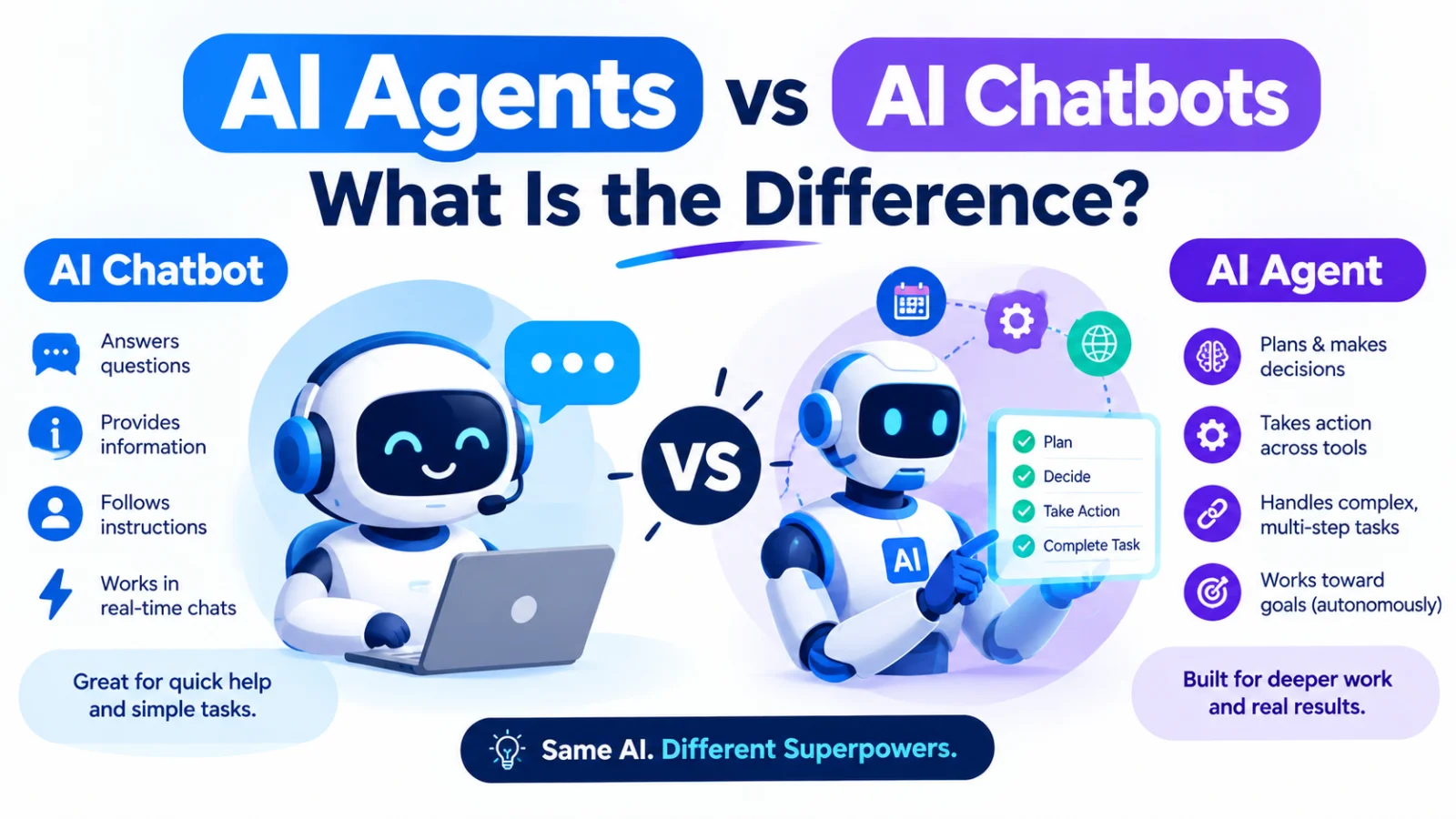

- Choose a chatbot for quick brainstorming, drafting content, language translation, and basic question answering.
- Choose an agent for multi step workflows, database updates, automated web research, and end to end task execution.
- Combine both tools by using chatbots for creative exploration and agents for operational heavy lifting.
Over eighty percent of businesses around the globe now use conversational software to communicate with customers and help employees work faster. Millions of people type questions into digital assistants every day to draft emails, summarize articles, and brainstorm ideas. While these conversation tools feel impressive, they still require a human to copy and paste the answers into other software. AI Agents vs AI Chatbots represents the next big shift in technology as software moves from talking about tasks to completing them independently.
Knowing the difference between these two technologies helps you choose the right tools for your business and personal projects. Chatbots excel at answering questions and generating creative text inside a chat box. Autonomous agents go much further by taking real actions across your computer programs without constant supervision. This complete guide breaks down how both systems work, where they differ, and how they are transforming digital work.
What Is an AI Chatbot?
An AI chatbot is a computer program designed to have conversations with human users through text or spoken voice. Modern chatbots use large language models trained on massive libraries of books, websites, and articles. When you type a prompt, the chatbot predicts the most helpful response based on the patterns it studied during training. It acts like a knowledgeable digital advisor that answers questions instantly.
Traditional chatbots followed strict prewritten scripts with fixed buttons and limited choices. Modern conversational bots can discuss almost any topic, translate foreign languages, and write computer code on command. However, a chatbot remains fundamentally passive because it only speaks when spoken to. It cannot leave the chat window to click buttons or execute software tasks on your computer.
The primary benefit of a chatbot is speed and conversational clarity. You can ask a chatbot to rewrite a messy paragraph, explain a math problem, or summarize a long meeting transcript. The tool delivers a clear written answer in seconds, saving you mental effort. You remain responsible for taking that written text and putting it to work in the real world.
What Is an AI Agent?
An AI agent is an autonomous software program that receives a broad goal and figures out how to achieve it without human intervention. Instead of stopping after writing a text response, an agent takes active steps across multiple digital tools. It observes its digital environment, makes a multi step plan, executes individual actions, and checks its own work. If a step fails, the agent revises its approach and tries another method until the job is complete.
These autonomous tools connect directly to web browsers, databases, and software applications through application programming interfaces. You can give an agent a high level objective like "research our top five rivals and update the sales spreadsheet." The agent browses the web, gathers pricing data, opens the spreadsheet, and enters the numbers automatically. It acts like a digital employee rather than a simple conversation partner.
Agents possess the ability to make logical decisions based on changing conditions. If an agent tries to book a flight and finds the price has doubled, it checks company travel rules to see if it should proceed or look for alternatives. This independent problem solving allows agents to handle complex, multi step workflows with minimal oversight. It represents a massive leap forward in software capability.
Reactive Conversation Versus Proactive Execution
The biggest difference between these two technologies is how they begin their work. Chatbots are purely reactive systems that wait quietly for a human to submit a prompt. Once the chatbot prints its response on your screen, its job is finished until you provide another instruction. You must manage the overall project flow, break down tasks, and execute every step manually.
Agents are proactive systems built around continuous goal pursuit. When you assign an objective to an agent, it creates its own internal task list and executes each item in sequence. It monitors external events, alerts you to potential problems, and completes routine duties on scheduled intervals. This proactive nature allows agents to manage complex operations in the background while you focus on high priority creative work.
A chatbot requires you to be present for every single step of a project. You must ask for an outline, then ask for a draft, then ask for edits, and finally copy the text yourself. An agent takes the initial goal and handles all those intermediate steps automatically while you sleep. The shift from reactive typing to proactive execution saves massive amounts of time.
Tool Use and Taking Real Action in the Digital World
Output capability is another massive divide between simple bots and autonomous agents. A chatbot generates text, computer code, or image suggestions that live solely inside the conversation window. If you ask a chatbot for flight recommendations, it produces a tidy text list of airlines and ticket prices. You still have to open your web browser, go to the airline portal, and enter your credit card information by hand.
An agent possesses the ability to interact with external tools and take real actions in the physical and digital world. An agent given the same travel request can open booking sites, compare prices, select the best flight, and complete the reservation. It uses software tools just like a human worker uses a keyboard and mouse. Giving software the power to use tools transforms simple text generation into true practical automation.
Modern agents can read spreadsheets, send emails through your email client, update customer records in databases, and trigger financial transactions. They interact with web pages by clicking links, filling out forms, and solving basic navigation steps. A chatbot can tell you how to do something, but an agent actually does it for you. This active capability makes agents far more powerful for business automation.
Planning, Memory, and Self Correction
Planning capabilities allow agents to tackle complex projects that require hours of structured effort. When an agent receives an assignment, it breaks the primary objective into small, logical subtasks. It determines which tools are needed for each step and establishes a timeline for completion. Chatbots lack this multi step planning architecture and treat each prompt as an isolated event.
Memory systems also separate advanced agents from basic conversational tools. Chatbots use short term memory that remembers only the current conversation thread, forgetting past context once the chat window closes. Agents utilize persistent long term memory to store company policies, user preferences, and past project results in secure databases. This stored knowledge helps the agent improve its performance and accuracy on future assignments.
Self correction is a vital feature that allows agents to handle unexpected software errors. When a chatbot encounters a broken web link or a software glitch, it simply prints an error message and stops. An agent analyzes the failure, searches for an alternative data source, and continues working toward the goal. This resilience makes autonomous agents dependable for unattended background workflows.
AI Agents vs AI Chatbots Comparison
| Feature Category | AI Chatbots | Autonomous AI Agents |
|---|---|---|
| Primary Function | Generating text answers and conversation | Planning and executing multi step goals |
| Operational Style | Purely reactive to human prompts | Proactive, independent, and self directed |
| Tool Interaction | Limited to text output in chat window | Interacts with APIs, browsers, and databases |
| Memory Capability | Short term memory for current chat | Long term memory stored across sessions |
| Error Handling | Displays error message and halts | Analyzes errors and tries alternate paths |
| Human Effort | Requires human input for every single step | Runs autonomously after receiving initial goal |
Everyday Workplace Scenarios Compared
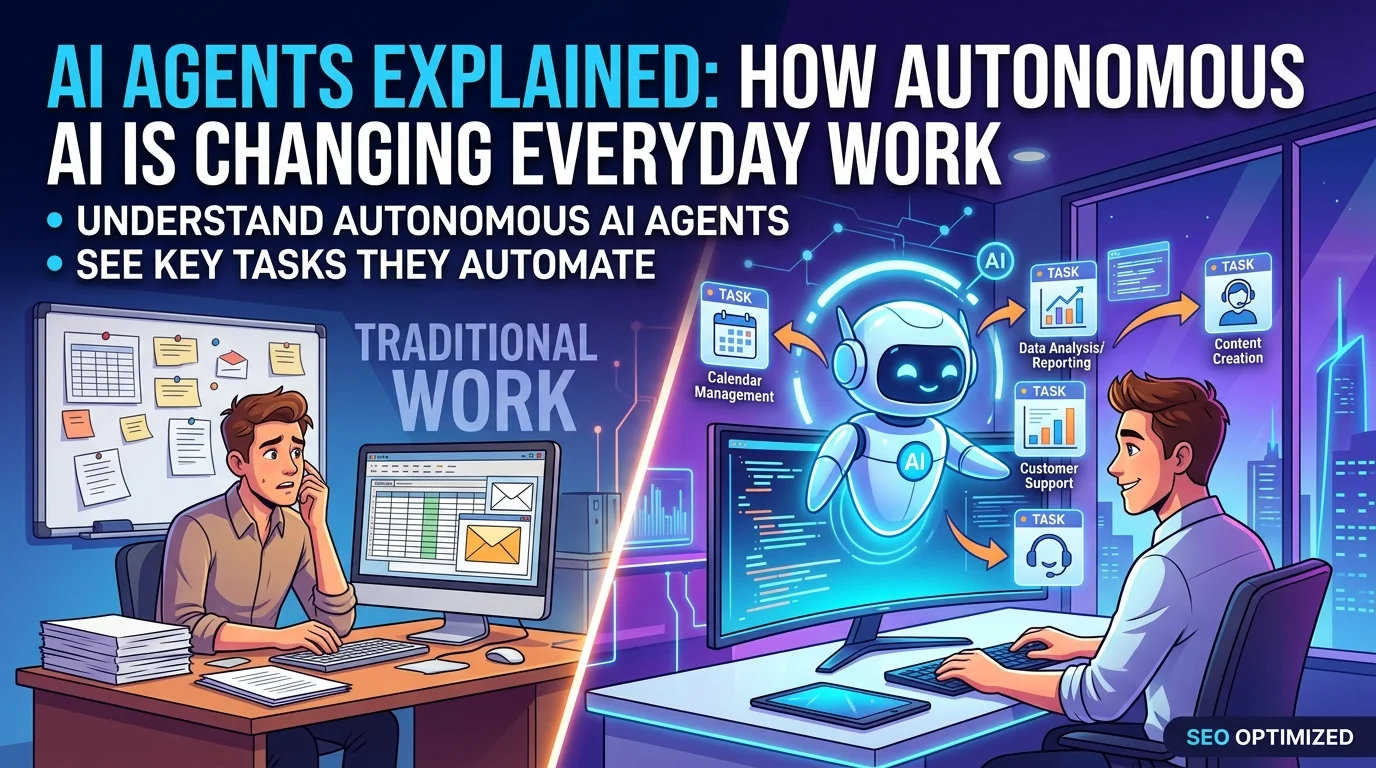
Examining everyday workplace scenarios shows how these differences play out in real business environments. In customer support, a chatbot answers frequently asked questions about return policies or store hours using prewritten text. A support agent goes much further by verifying customer identities, checking tracking numbers in the warehouse database, and issuing a replacement order. The agent resolves the entire customer problem without requiring human staff intervention.
Software development provides another striking example of this technological evolution. A coding chatbot can write a short function or explain what a specific error code means when asked. A software engineering agent can clone an entire code repository, run automated test suites, locate security bugs, and write a complete code patch. The agent tests its own fix to verify stability before submitting a pull request for team review.
Marketing teams experience massive productivity gains by shifting from chat prompts to autonomous execution. A marketer using a chatbot must ask for headline ideas, copy the results, request social captions, and schedule posts manually. An autonomous marketing agent monitors industry news, drafts relevant social updates, generates matching graphics, and publishes posts at peak engagement hours. The marketing team saves hours of repetitive administrative labor every week.
Multi Agent Collaboration: Virtual Teams Working Together
The true power of autonomous software appears when multiple specialized agents collaborate on a shared project. In a multi agent system, individual software programs are assigned specific roles based on their expertise. One agent might act as a data researcher, another as a technical writer, and a third as a quality control editor.
The researcher agent scours the web for facts and passes its findings directly to the writer agent. After the writer finishes drafting the document, the editor agent reviews the content against brand guidelines and factual accuracy. If the editor spots an error, it returns the draft with specific revision notes. This collaborative teamwork allows autonomous systems to complete sophisticated projects with minimal human supervision.
Single chatbot windows cannot replicate this distributed team dynamic easily. A human user must manually copy text back and forth between different prompts to simulate multi role collaboration. Multi agent networks handle this communication automatically through background data pipelines. Businesses can deploy entire virtual teams that work together around the clock.
Safety, Control, and Human Oversight
Giving software the authority to take independent actions introduces important safety considerations. Autonomous agents can make mistakes, misinterpret instructions, or encounter unexpected edge cases in software tools. Setting clear operational boundaries ensures that automated systems remain safe, predictable, and aligned with company goals.
Organizations use human in the loop checkpoints to maintain control over high stakes actions. Low risk tasks like gathering research, sorting emails, and drafting reports can run with full autonomy. High risk actions like signing legal contracts, sending wire payments, or deleting database records require explicit human approval. This balanced setup captures the speed of automation while protecting business assets.
Data security and access permissions must also be managed with care. Agents should only have access to the specific software tools and databases required for their designated tasks. Regular security audits of agent activity logs help teams detect unauthorized actions and software vulnerabilities early. Responsible governance ensures that autonomous software remains a safe and valuable corporate asset.
How to Choose the Right Solution for Your Needs
Deciding between an AI chatbot and an AI agent depends on your specific goals and budget. If you need a simple tool to answer customer questions, generate quick writing ideas, or translate documents, a chatbot is ideal. Chatbots are affordable, easy to set up, and require zero technical integration with your existing software stack.
If your goal is to automate complex workflows, connect multiple software tools, and eliminate repetitive manual tasks, an agent is the right choice. Agents deliver massive efficiency gains by handling multi step operations from start to finish. While agents require more setup time and technical integration, the long term productivity benefits are substantial. Matching the technology to your operational bottlenecks ensures maximum return on your investment.
The Future of Automated Digital Work
The boundary between conversation and action will continue to blur as artificial intelligence develops. Future software applications will combine conversational ease with autonomous execution by default. You will be able to speak naturally to your computer, describe a complex project, and watch software agents execute the work in real time.
Human workers will shift from being manual task executors to strategic directors and creative coordinators. Instead of spending hours managing spreadsheets and scheduling meetings, employees will guide teams of specialized digital agents. This evolution will make daily work more creative, engaging, and impactful. Organizations that embrace these automated capabilities will lead their industries in efficiency and innovation.
As natural language processing and computer vision continue to improve, agents will handle physical and digital environments with greater precision. They will manage entire supply chains, coordinate international logistics, and conduct scientific research alongside human scientists. Staying familiar with these tools today prepares you for the automated workplace of tomorrow. The journey from simple chat boxes to active digital partners is reshaping the global economy.
Step Into the Future of Automation Today
Understanding the difference between AI agents and AI chatbots helps you choose the best tools for your personal and professional growth. While chatbots excel at generating helpful conversation, autonomous agents take the next step by completing real tasks across your digital workspace. Combining both technologies gives you unmatched speed, creative freedom, and operational power.
Start exploring how autonomous technology can improve your daily workflow today. Review your weekly routine, identify repetitive administrative tasks, and test a modern agent tool to experience true digital assistance. Step into the future of automated productivity and let smart software handle the busywork for you.


Discussion
No comments yet. Be the first to share your thoughts!
Leave a Comment